Thursday, June 16, 2011

The Cost of Doing Buisness

 Pricing: How Much Time Are You Really Spending on Your Product?


We all know the formula:
Cost Price (Labor + Materials Cost) x 2 = Wholesale Price 
Wholesale Price x 2 = Retail Price


But what goes into the cost of our labor? 
Time!

A day in the life of an Etsy Item
Aside from what you spend on supplies and incidentals, which is relatively easy to track, what about the time you put in? If you are like me, you do not weigh time heavily into the equation because you are so happy while you are in creative mode, and you forget about all of the other stuff.  Recently I have taken a hard look at my time management for pricing purposes and life in general.

Sad but true, time is money, even when it feels like you should be paying someone for the happiness you get from making jewelry.


Lets look at one little piece of jewelry, and all it has to go through to get into the hands, or onto ears or necks of my customer, (not exactly in order of appearance).

Little Piece of Jewelry
  • The research process - this is what I like to call it when I am  daydreaming up new ideas.
  • The sketch – you can skip this  part if you do not need to sketch, but I do. Here are your five minutes back if you don't.
  • Learning and practicing techniques, or, how the heck do I make this? This can include: time spent in trial and error, in courses, reading books, taking Ecourses, or tutorials.
  • Ordering or shopping for Supplies.
  • The actual designing proces.

  • Actually fabricating your piece
  • Modeling it for your significant other or furbaby and telling them they are not excited enough about this new creation.

    Not Really Me
    • Photographing it.
    • The dreaded editing of said photographs.
    • Determining pricing which includes more dreaded research and, yikes, math.
    • The even more dreaded listing of item.
    • Answering stupid and not so stupid convos.
    • Tweeting, FB-ing, Stumbling, Deliciousing, Stylehiving, Pinteresting, Kaboodling, Blogging, making the dreaded Treasury (I make them, but I don’t like them), commenting on T's, and more.
    •    Doing all of the above for your team members, as they have done for you.
    • Messing with Etsy on Sale. Should I, shouldn't I? etc. 

    • Promoting your sale if you chose "I should."
    • Rearranging your Etsy store obsessively
    • Renewing
    • Checking Craftopolis
    • Checking Google Analytics and wondering if anyone really understands it.
    • Worrying about your SEO and asking Bob a lot of questions: 1800-jewelry24Seven
    • Creating and promoting coupons, or wondering if you should.

     
    Finally,  a sale!

     
    Continuing on...
    • Ordering or shopping for packing supplies.
    • Putting your precious piece into pretty packaging that you ordered or made.
     

    • Packing for safe shipping.
    •  Printing a label, cursing at printer %&*((%!!  *(__$%^&!!!.
    • Fixing the printer or running to Staples for more printer ink.
    •  Printing again.
    • Going to the post office.
    • Swearing I am going to get more organized so I can arrange home pick up, which is FREE.
    • Following up emails (yup, you bought it, yeah, its coming etc.).
    •  Worst case, tracking a package. uuugghhhhhh.
    • Best case, happy customer, brilliant feedback, Yayyy.

    Guess what, time to start all over again.

    All of this is not even factoring in the very important time spent on the JET Thread!

     
    Is your pricing right?
    Do not sell yourself short. Much of the cost of doing business is our time!


    Thanks for reading,

    Wednesday, June 15, 2011
    JET Interview - Trace Designs

    Trace Designs: Simple Design, Bold Color

    Trace Designs  was born from a single, simple earring class at a local bead shop. That one class was enough to create a full fledged addiction to making pretty things.
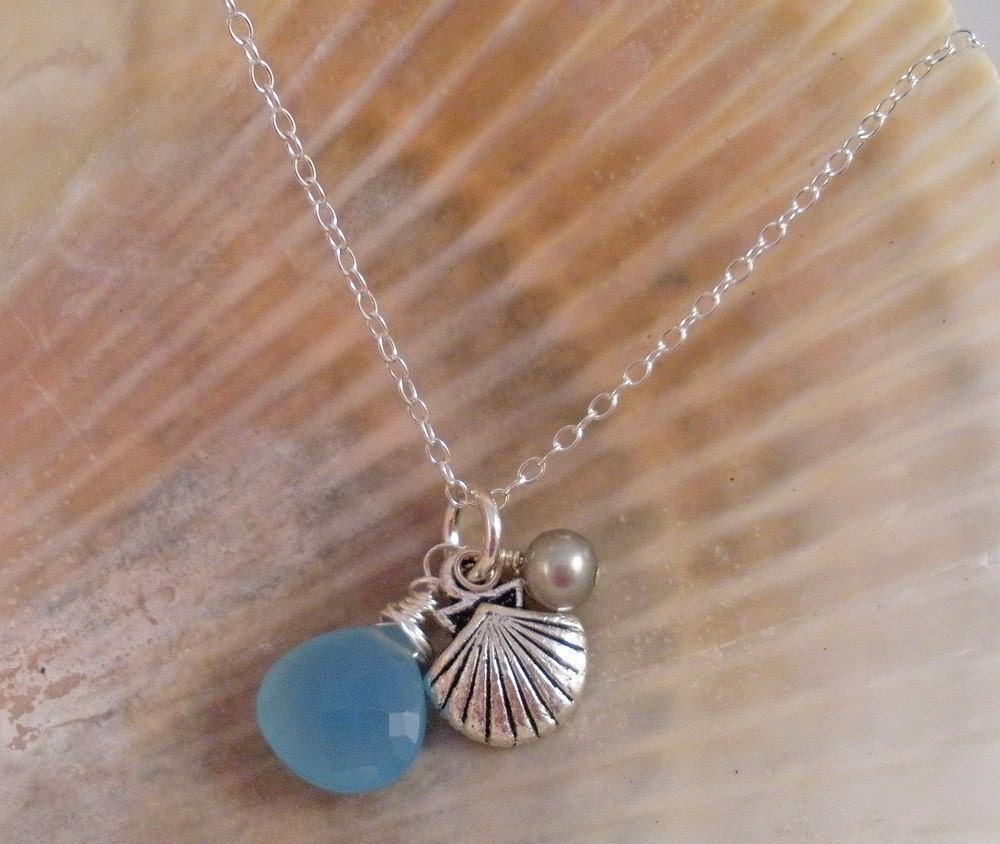
    Aquamarine Blue and Antiqued Silver Necklace and Earring Set
    Aqua Blue Teardrop Earrings on Sterling Silver earwire

    At first, I was creating for myself, creating jewelry that I couldn’t find in stores, but rather the things I imagined in my head; things that suited my personal style.


    I then started making too many of these things… started giving them away as gifts; and  stockpiling for Christmas in March. My (very large) jewelry box was simply overflowing. I noticed that people liked my handmade jewelry and began asking if I sold my pieces. Then, I discovered Etsy.com....

    Golden Freshwater Pearl and Quartz Necklace
    Bright Orange Rose Earrings

    The designs themselves are simple. There is nothing complex or overly embellished, rather, my designs allow for the colors and beads to show their true beauty. I love to let bold colors sing or a truly amazing bead tell its own story.


    If its one thing I don’t fear, its color! This is where my shop, I think, really pops. I love combining colors that enliven each other to create something truly unique.

    Lime Green and Regatta Blue Limestone Necklace

    At other times I love to let simply gorgeous tones stand alone with sterling silver as a backdrop or with antiqued sterling silver to evoke a more vintage feel.


    I’m always learning new techniques so the pieces in my shop are constantly evolving. I’ve recently begun creating hammered sterling silver earrings with free form organic shapes. Please visit my shop  to get a glimpse of new adventures over the next few months!

    Monday, June 13, 2011

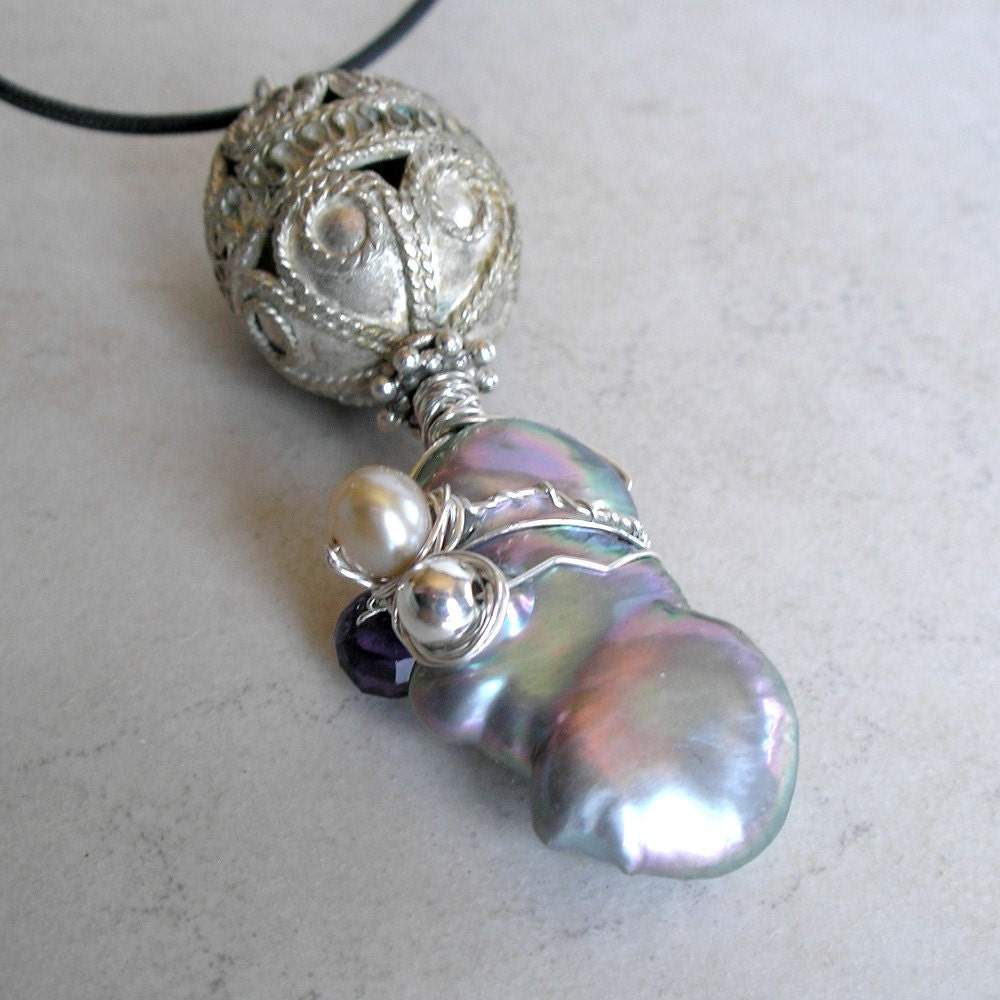
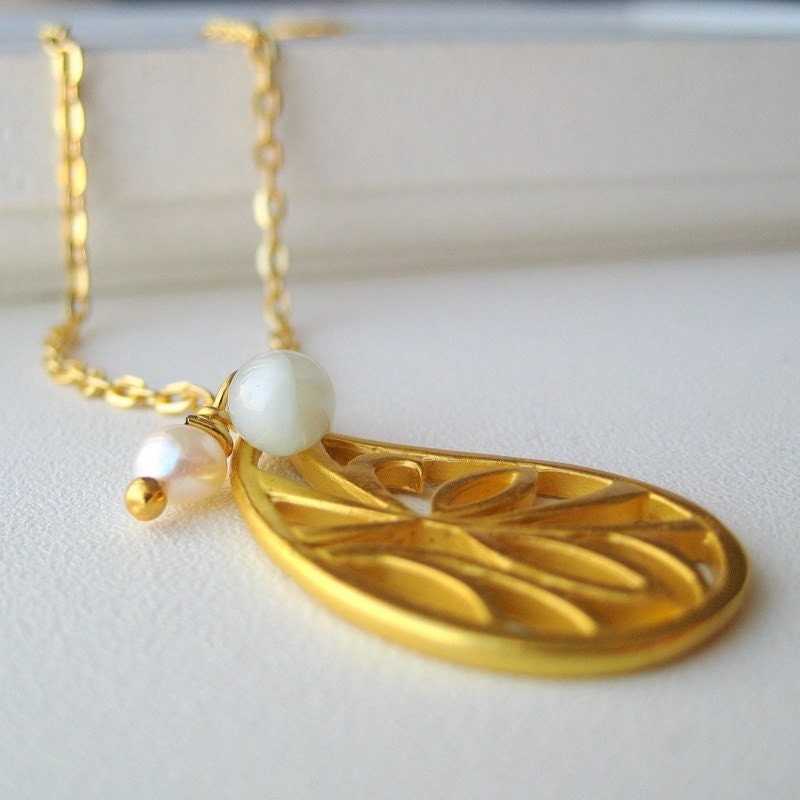
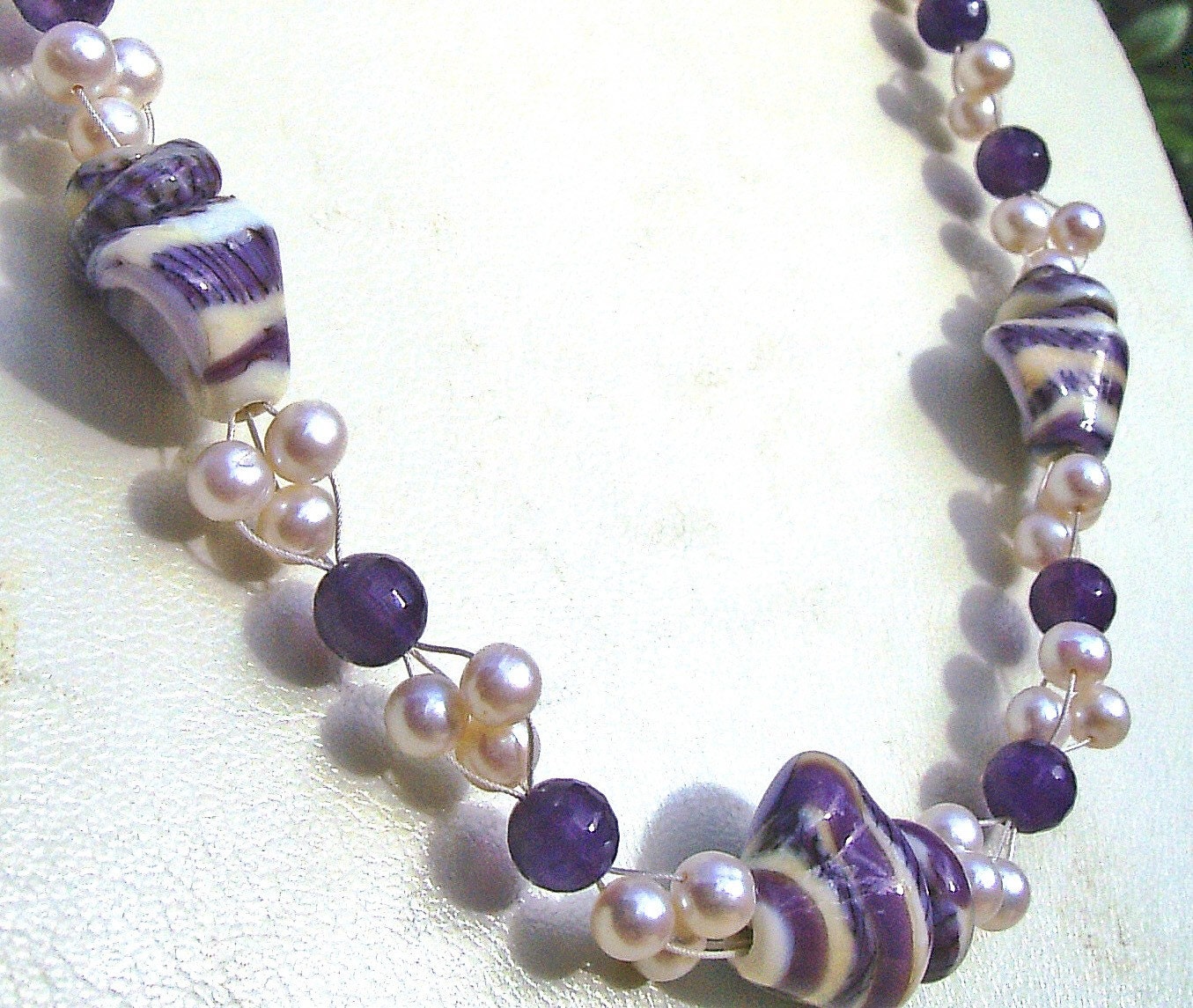
    Good Stuff To Know About Pearls ( June’s Birthstone)


    Pearls fit into two categories: freshwater and saltwater. As their name implies, freshwater pearls are formed in freshwater mussels that live in lakes, rivers, ponds and other bodies of fresh water. By contrast, saltwater pearls grow in mollusks that live in the ocean.


    Natural pearls are those pearls that are formed in nature, more or less by chance. Cultured pearls are those in which humans lend a helping hand, such as in China’s dominating freshwater pearl farms. Today more than 99% of all pearls sold worldwide, both fresh water and salt water, are cultured pearls, "designed" from the start to be primarily flawless.


    The Different Types of Pearls 

     
     Akoya Pearls are the pearls most people think of when they think of pearls. Perfectly round, gleaming and lustrous, white Akoya pearls were the very first cultured pearls available anywhere in the world. The classic look still reigns today as the definitive standard of the pearl industry. Akoya pearls are saltwater pearls from both Japan and China, and generally range in size from tiny 2.0-3.0mm seed pearls to the largest and rarest 9.5-10.0mm sizes.


    Black Tahitian Pearls are rare black pearls from French Polynesia, shimmering with vibrant overtones that are unmistakable and unforgettable. Popular overtones include Peacock, which is a green-gold mix tinged with rose, to Aubergine or deep eggplant; silver and steel tones, and aquamarine or shades of blue-green, all laid over a palette of dove and dark charcoal greys..

    Traditionally ranging from 8.0mm up to 16.0mm in size, their glamorous sizes, combined with their unique, naturally-occurring range of greys and blacks make these pearls very desirable.


    South Sea Pearls: large and luminous in white and golden from Australia and the Philippians are the largest and rarest of all cultured pearl types in the world. Pearls cultured in the Pinctada maxima saltwater oyster, which can grow up to a foot in diameter at maturation, routinely obtain sizes that range from 9.0mm up to an astonishing 21.0mm! The pearls’ golden and white colors are completely natural, needing no dyes or artificial enhancements.


    Cultured South Sea pearls are also known for their soft, satiny glow which is due to their thick nacre layers, acquired through as much as 4 years’ cultivation time.


    Freshwater pearls come in a variety of colors and shapes to suit every taste, occasion, and budget; from perfectly round, gem-quality pearls to cute button-shapes. Known for their natural pink, lavender and classic white hues, freshwater pearls are an affordable choice that brings the beauty of pearl jewelry to many, without sacrificing quality. 


    Fresh water pearls are often dyed or irradiated and it is usually not difficult to tell whether a pearl's color is natural. There is even a tutorial in Fire Mountain Gems on how to dye your own freshwater pearls!


    There are several different types of Freshwater Pearls that you may be familiar with:


    The most famous type of freshwater cultured pearl is the Biwa  pearl which used to come from mussels grown in Lake Biwa, Japan’s largest freshwater lake which is now polluted. These grow to become what we know as “stick” pearls

    Keshi (sometimes spelled Keishi) Pearls ( my favorites)


    Keshi (in Japanese it means "poppy seed") may be salt or freshwater and are sub-products of the pearl. Basically, pearl garbage. When the oyster rejects a nucleus or a pearl, the fragments of epithelium may yield keshi, baroque-shaped pearls of small diameter which have no nucleus. Keshis come in different size, shapes and coloration.


    Mother of Pearl is the iridescent substance that forms the lining of the shells of some fresh-water and some salt-water mollusks. Mother of Pearl jewelry is  made from the inside part of the oyster shell. Like the pearl it is a secretion of the mantle, (nacre). Among the chief sources are the pearl oyster, found in warm and tropical seas, chiefly in Asia; freshwater pearl mussels, which live in many rivers of the United States, Europe, and Asia; and the abalone of California, Japan, and other Pacific regions.


    To learn more about pearls, how they are made, their role in history, how they are graded, etc. there is a beautiful exhibit, full of really interesting info. at the online site of the American Museum of Natural History-online

     also, great information on PBS at The Perfect Pearl.


    Everyone loves pearls


    Don't for get to scroll down for some JET Pearls! 
    Thanks for reading,